Source: People's Daily | January 14, 2025, 15:37:34
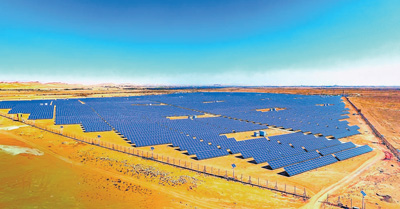
Original Title: The Photovoltaic Industry in Africa is Developing Steadily (International Perspective)
The photovoltaic power station project constructed by PowerChina in southern Algeria has a total installed capacity of 233 megawatts, and its annual power generation can meet the electricity needs of about 200,000 households. The picture shows a scene of the project. Provided by PowerChina.
Africa is rich in solar energy resources and has great potential for the development of the photovoltaic industry. In recent years, African countries have continuously introduced policies and measures to accelerate the construction of photovoltaic projects, which has become a highlight of the development of renewable energy in Africa. Chinese enterprises are actively helping African countries develop the photovoltaic industry, and the cooperation in the photovoltaic industry between China and Africa shows broad prospects.
Newly Installed Capacity Breaks Records
The report "Solar Annual Outlook 2024: A Review of the Solar Status of African Countries" recently released by the African Solar Energy Industry Association shows that the newly installed photovoltaic capacity in Africa in 2023 was 3.74 gigawatts, a year-on-year increase of 19%, setting a record, and the total installed capacity reached 16.3 gigawatts. Among them, South Africa ranked first, and Burkina Faso, Mauritania, Kenya, the Central African Republic, Côte d'Ivoire, Egypt and other countries were also among the top in terms of newly installed photovoltaic capacity in African countries.
South Africa is the country with the largest photovoltaic installed capacity in Africa. According to the data of the South African Photovoltaic Industry Association, by the end of 2024, the cumulative photovoltaic installed capacity in South Africa was about 8.97 gigawatts. Currently, there are 40 photovoltaic project tenders in South Africa, with a total installed capacity of 8.526 gigawatts, distributed in the Free State Province, Limpopo Province, North West Province, Mpumalanga Province, Northern Cape Province and other places. In addition, the South African government also introduced a series of policies in 2024 to encourage the development of the photovoltaic industry, including simplifying the approval process for photovoltaic projects, etc., to attract more investors to participate in the construction of photovoltaic projects in South Africa.
According to the latest data of the International Renewable Energy Agency, by 2024, the photovoltaic installed capacity in Egypt was about 1.9 gigawatts, ranking second among African countries. In December last year, a photovoltaic power station with an installed capacity of 500 megawatts in Aswan Province, Egypt was completed. It is expected to generate 1500 gigawatt - hours of electricity annually, which is enough to supply about 300,000 Egyptian households. Egyptian Prime Minister Mostafa Madbouly said that the project is of great significance for Egypt's economic development and energy stability. According to the relevant plan of the Egyptian Ministry of Electricity and Renewable Energy, the goal is to achieve 42% of the national power generation from renewable energy by 2030, and the proportion of photovoltaic power generation is about 22%. It is estimated that this requires an additional 31 gigawatts of photovoltaic installed capacity. Last year, the Egyptian government also reached a $700 million financing plan with the World Bank for the development of renewable energy projects, including the photovoltaic industry.
The Moroccan government is also actively promoting the development of the photovoltaic industry. The "World Energy Statistical Yearbook 2024" released not long ago shows that the total installed capacity of photovoltaics in Morocco reached 0.394 gigawatts. The Moroccan government has set a goal of 52% of total power generation from renewable energy by 2030, and encourages enterprises to build large-scale photovoltaic projects through measures such as preferential land and tax exemptions. As one of the largest renewable energy projects in Morocco, the third - phase project of the Noor Solar Power Park has an installed capacity of 400 megawatts. Currently, the project is in the licensing stage and is expected to be put into commercial operation in 2026.
Jide Ijiyado, the Africa Director of the ClimateWorks Foundation's Global Energy Transition, believes that African countries' active promotion of the development of the photovoltaic industry not only helps to solve the energy shortage problem but also contributes to promoting economic development, creating job opportunities, and reducing environmental pollution.
Many Countries Introduce Industrial Support Measures
Energy shortage is a common problem faced by African countries. Statistical data recently released by the International Renewable Energy Agency shows that currently, the number of people without electricity in sub-Saharan Africa reaches 570 million, accounting for more than 80% of the global population without electricity. By 2030, hundreds of millions of people in Africa will still not have access to electricity. At the same time, Africa is rich in solar energy resources. A report by the International Energy Agency shows that Africa's solar energy reserves account for 40% of the global total, providing unique natural conditions for the development of the photovoltaic industry.
Many African countries regard the development of the photovoltaic industry as an important means to alleviate the power shortage in their own countries and achieve sustainable development. In March last year, Tanzanian Vice - President and Minister of Energy, January Makamba, attended the groundbreaking ceremony of the 50-megawatt Sengerema Photovoltaic Power Station project. The Sengerema Photovoltaic Power Station constructed by PowerChina is the first photovoltaic project in the country and is of great significance for the development of new energy in Tanzania. January Makamba said that he hopes the project will be completed on schedule with high quality to provide important support for alleviating the power shortage in Tanzania and promoting local economic and social development.
In March last year, the Kenyan government launched a plan to expand renewable energy investment based on the national renewable energy development strategy, and regarded the photovoltaic industry as one of the key development areas. The Kenyan government plans to build several large-scale photovoltaic power stations in the next few years and encourage the installation of distributed photovoltaic power generation systems in rural and remote areas. To achieve this goal, the Kenyan government has provided policy support such as financial subsidies and loan preferences, and at the same time strengthened cooperation with international organizations and enterprises to introduce advanced photovoltaic technologies and management experience.
The Cameroonian government announced that from January last year, it would exempt import duties and other taxes on photovoltaic equipment components to support the development of the renewable energy industry. In late March last year, the Algerian national utility company signed contracts with several local and international companies to build 20 photovoltaic projects with a total installed capacity of 3 gigawatts. In August last year, the South Sudanese Cabinet approved a $150 million solar project to build a 5-megawatt photovoltaic power station in the capital Juba.
The African Development Bank said in a report that the development of the photovoltaic industry will create new job opportunities for African countries, and at the same time help promote the rise of the local manufacturing industry, facilitate technology transfer and innovation, and improve Africa's position in the global industrial chain. The Algerian newspaper "L'Orient - Le Jour" said that the power infrastructure in Africa is scarce, and photovoltaic power generation can provide clean energy for more remote areas. The development of the photovoltaic industry can also reduce the dependence on fossil energy and promote environmental protection and sustainable development.
The Photovoltaic Cooperation between China and Africa is Deepening
In recent years, China and African countries have continuously deepened cooperation in the photovoltaic industry. The latest data shows that the cumulative installed capacity of photovoltaic power stations jointly built by China and Africa has exceeded 1.5 gigawatts, providing support for Africa to alleviate energy shortages and address climate change.
In Egypt, China Power Complete Equipment Co., Ltd. signed a memorandum of understanding with the Egyptian New and Renewable Energy Authority and the Egyptian Electricity Holding Company in January last year to jointly develop a large-scale 10-gigawatt photovoltaic project. The Egyptian newspaper "Al - Ahram" said that after the project is completed, it can provide a large amount of clean energy every year, helping to reduce about 14 million tons of carbon emissions.
In Eritrea, the signing ceremony of the 30-megawatt photovoltaic energy storage general contracting project in the Dekemhare region of Eritrea, the first photovoltaic energy storage project of China Energy Engineering Group in the country, was held in February last year. Local media reported that the project has a construction capacity of a 30-megawatt photovoltaic power station + a 15-megawatt / 30-megawatt-hour energy storage system. After completion, the project will effectively improve the local power supply, reduce power costs, and promote the diversification of energy sources.
In Garissa County in northeastern Kenya, the 50-megawatt Garissa Photovoltaic Power Station constructed by Chinese enterprises is the largest photovoltaic power generation project in East Africa so far. Since its official operation in 2019, the Garissa Photovoltaic Power Station has an average annual power generation of more than 76 million kilowatt - hours, which can meet the electricity needs of 70,000 households with a total population of more than 380,000. At the same time, it can help Kenya save about 24,470 tons of standard coal and reduce carbon dioxide emissions by about 64,000 tons every year...
Demissew Mengistu, a researcher at the Ethiopian Policy Research Institute and a professor at Addis Ababa University, said in an interview with our reporter that China has advantages such as mature technologies and large-scale production capacity in the photovoltaic field. China cooperates with African countries in the photovoltaic industry with an open attitude, helps Africa's green development cause, and contributes to the global response to climate change.